I WISH SPECIAL OFFER [BOOK NOW]

Lichen
Sclerosus
Program
Lichen sclerosus is a chronic condition affecting vulvar tissue — and it deserves more than symptom control. At IWish, our program follows ISSVD guidelines as the foundation, then goes further: restoring tissue health, preserving anatomy, and returning women to comfort, confidence, and quality of life.
Grounded in ISSVD Guidelines
Our program uses the International Society for the Study of Vulvovaginal Disease (ISSVD) standards of care as its clinical foundation — then builds upon them with advanced therapies unavailable at most practices.
Beyond Standard Care
Where conventional management ends, our protocol continues — integrating laser therapy, regenerative medicine, surgical correction, and hormonal optimization as a unified, phased approach.
Understanding the Condition
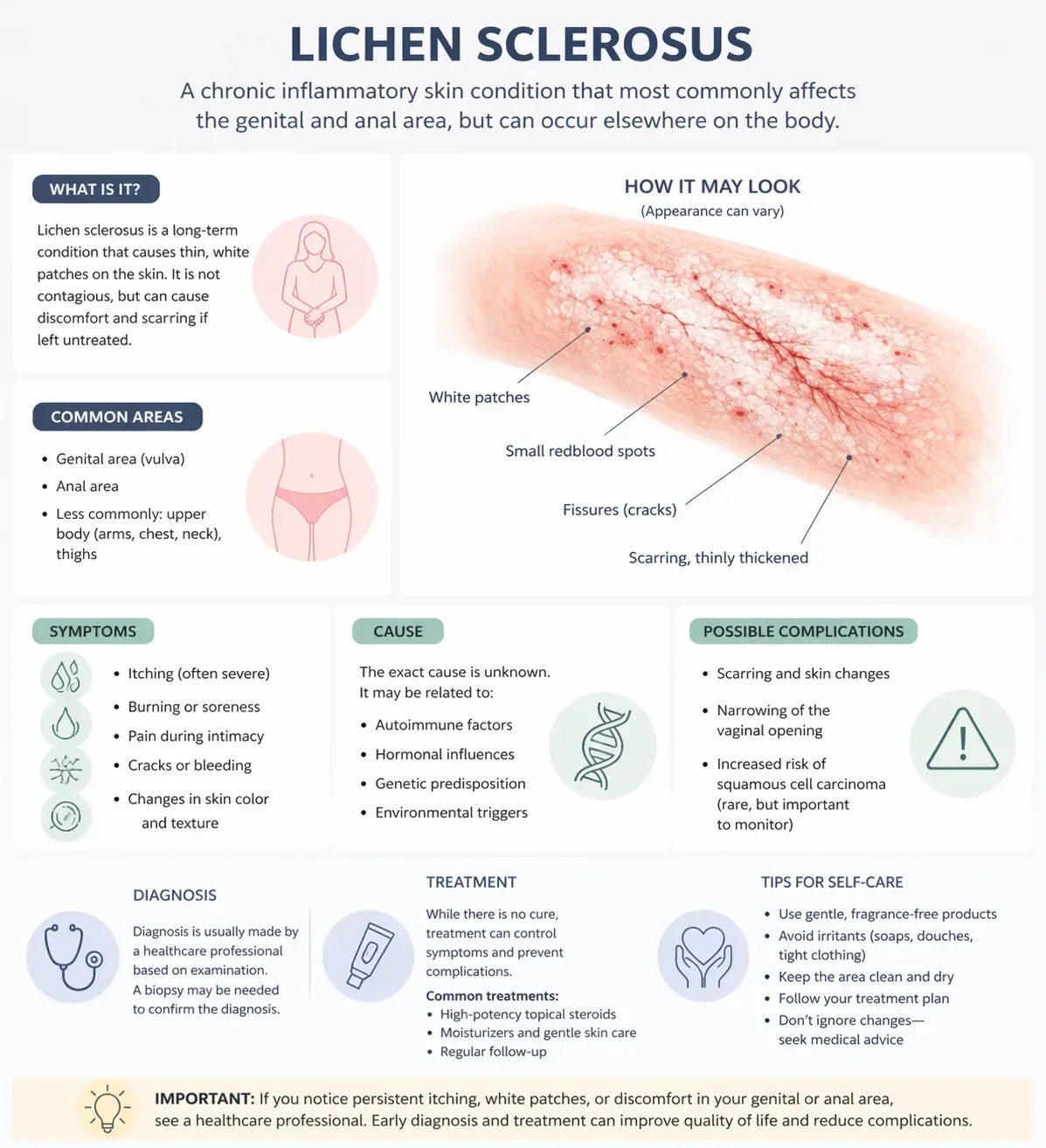
What Is Lichen
Sclerosus?
Restorative gynecologic surgery addresses the structural consequences of events outside your control — traumatic delivery, surgical complications, tissue atrophy, and scarring from inflammation. Unlike purely cosmetic procedures, these surgeries restore physiologic function: eliminating pain with intercourse, restoring tissue integrity, and repairing anatomical structures that affect daily quality of life.
Dr. Bahnmiller brings specialist-level anatomical expertise to every restorative procedure — understanding that these patients often carry years of discomfort, failed treatments, and dismissed concerns. This is where that ends.
Chronic Condition
Immune-Mediated
Vulvar Tissue
Elevated Cancer Risk
Treatable
ISSVD Guidelines
Side-by-Side
Standard Care vs.
The CSRH Protocol
The ISSVD standard of care provides an essential clinical foundation. At CSRH, we use it as a starting point — not a ceiling. Every category where conventional care stops short is an opportunity to restore what standard management leaves behind.
| Category | ISSVD Standard of Care | CSRH Advanced Protocol |
|---|---|---|
| Primary Goal | Symptom control, prevent scarring, reduce cancer risk | Symptom control, prevent scarring, reduce cancer risk + Restore tissue health & function |
| First-Line Treatment | Clobetasol | Clobetasol + detailed patient education and technique coaching |
| Steroid Regimen | Daily → taper | Structured, individualized protocol with scheduled tapering |
| Application Guidance | General instructions | Detailed application coaching to maximize efficacy and compliance |
| Maintenance | Intermittent as needed | Structured maintenance protocol + Vulvoscopy surveillance |
| Adjunct Support | Emollients | Expanded support — barrier creams, compounding, lifestyle guidance |
| Laser Therapy | Second-line consideration | CO₂ laser (Monalisa Touch) Integrated into Phase 2 protocol |
| Regenerative Therapy | Limited / not standard | PRP and exosomes offered as part of tissue restoration phase |
| Sexual Function | Under-addressed | Core clinical focus Treated as essential, not optional |
| Anatomic Correction | Late-stage surgical referral | Preventative & restorative surgery available in-house |
| Cancer Monitoring | Routine monitoring | Enhanced surveillance education + structured vulvoscopy schedule |
| Overall Experience | Disease control | Concierge-level care Disease control + tissue restoration |
Scar Revision
Our 6-Phase
Treatment Protocol
Phase 01
Stabilization
Clobetasol Therapy & Technique
The foundation of LS management. We prescribe clobetasol propionate with structured daily-to-taper dosing, combined with hands-on application coaching — ensuring maximum therapeutic effect and patient confidence in self-management.
Structured clobetasol dosing protocol
Application technique coaching
Barrier emollient support
Initial symptom tracking and benchmarking
Phase 02
Tissue Restoration
CO₂ Laser Therapy
Once inflammation is stabilized, fractional CO₂ laser therapy (MonaLisa Touch) is integrated to stimulate collagen remodeling, restore mucosal integrity, and reverse structural changes — going beyond symptom control to genuine tissue regeneration.
MonaLisa Touch fractional CO₂ laser
Collagen remodeling and tissue restoration
Improved elasticity and mucosal health
Reduced adhesion risk with early intervention
Phase 03
Refractory Disease
Tacrolimus & JAK Inhibitors
For patients who do not achieve adequate response with first-line therapy, we employ advanced immunomodulatory agents — including tacrolimus and JAK inhibitors — targeting the underlying inflammatory pathway driving disease activity.
Tacrolimus (calcineurin inhibitor)
JAK inhibitor therapy where indicated
Combination protocols for resistant disease
Close monitoring during advanced therapy
Phase 04
Structural Correction
Surgical Options
When LS causes anatomical change — clitoral adhesions, phimosis, labial fusion, or significant architectural distortion — surgical correction is available in-house. Early referral for surgical evaluation prevents progressive structural loss.
Clitoral adhesion release
Clitoroplasty and clitoropexy
Labial reconstruction and scar revision
Preventative surgery to preserve anatomy
Phase 05
Hormonal Optimization
Estrogen ± Androgen Therapy
Hormonal deficiency — particularly estrogen and androgen — worsens LS disease activity and impairs tissue resilience. Hormonal optimization is integrated as a clinical tool to support tissue health, improve treatment response, and restore sexual function.
Local and systemic estrogen therapy
Testosterone optimization where indicated
DHEA for mucosal and tissue support
Integration with ongoing LS management
Phase 06
Maintenance
Long-Term Care & Surveillance
Lichen sclerosus requires lifelong management. Our maintenance program includes structured steroid protocols, scheduled vulvoscopy surveillance for early detection of dysplasia or malignant change, and ongoing support for sexual health and function.
Structured long-term steroid maintenance
Vulvoscopy surveillance schedule
Cancer risk monitoring and education
Ongoing sexual function support
Our Approach
"At CSRH, we treat lichen sclerosus not just as a condition to control —
but as tissue to restore."
IWish Lichen Sclerosus Program · Dr. Daniel Bahnmiller, DO
What We Address
Care That Goes
Beyond Control
Tissue Health &
Restoration
Laser therapy and regenerative treatments that actively restore vulvar tissue integrity — not just slow its deterioration. CO₂ laser and PRP/exosomes work in parallel with medical therapy.
Sexual
Function
Sexual pain, loss of arousal, and orgasmic dysfunction caused by LS are core clinical targets — not secondary concerns. Every treatment plan addresses sexual health as a primary outcome.
Anatomy
Preservation
Preventative surgical intervention to address adhesions and structural changes before they become irreversible — preserving clitoral exposure, labial architecture, and vaginal access.
Cancer
Surveillance
Structured vulvoscopy monitoring and enhanced patient education around malignant transformation risk — with a clear protocol for escalation if concerning changes are identified.
Understanding the Condition
Concierge-Level
Disease Management
Most women with lichen sclerosus receive a prescription and a follow-up in six months. At IWish, the experience is fundamentally different — built around physician-led, structured, ongoing care that adapts as your disease does.
Physician-directed at every phase — no nurse-only management
Structured protocol with clear milestones, not open-ended monitoring
Vulvoscopy surveillance built into the maintenance phase
Sexual health treated as essential, not incidental
In-house surgical capability — no referral delays for structural correction
Integration with regenerative and hormonal therapies unavailable elsewhere
Ready to Start a
Real Treatment Plan?
Schedule a comprehensive Lichen Sclerosus evaluation with Dr. Bahnmiller — the Tri-Cities' only subspecialist offering the full spectrum of LS care from medical management through surgical correction.
Institute for Women's Intimate Surgery & Health
Expertise in Intimate Wellness & Surgical Precision.
Dr. Daniel Bahnmiller, DO
Women's Intimate Health & Cosmetic
Gynecologic Surgeon
Founder, IWish at CSRH
Services
Procedures
Connect
© 2026 IWish — Institute for Women's Intimate Surgery & Health. All rights reserved.
A Division of Columbia Shores Regenerative Health